
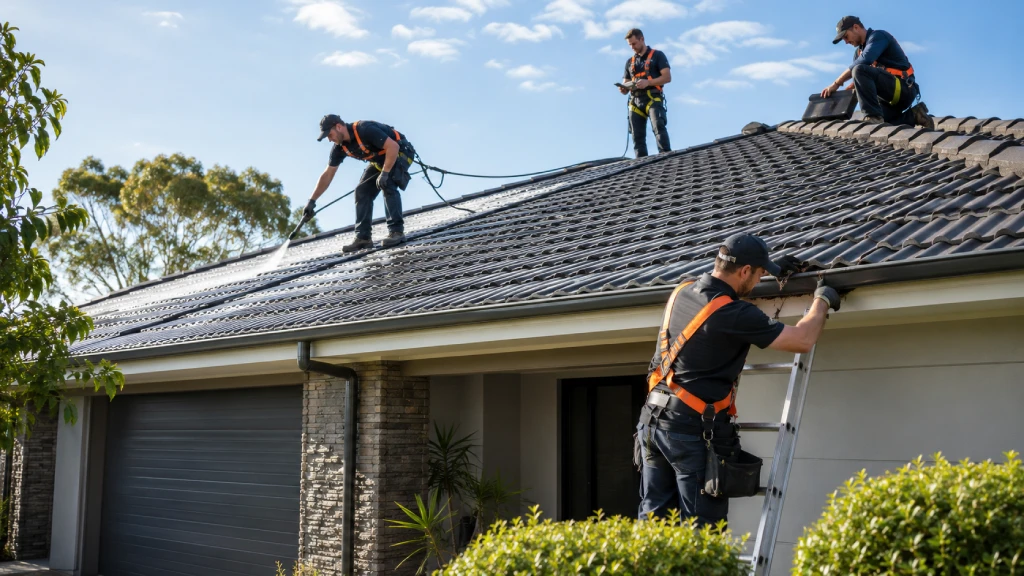
There’s a moment every Central Coast homeowner eventually has. You’re in the driveway, maybe bins in hand, and you glance up — actually up, not the usual half-second check — and something in your gut goes “oh, that’s not great.” A patch of moss the size of a doormat. A tile sitting at an angle it definitely wasn’t sitting at last summer. A gutter that’s gone from “silver” to “the colour of weak tea.”
Welcome to the club. It’s a big club. Salt air, summer storms that arrive like they’ve got a personal vendetta, and that relentless coastal sun don’t exactly tiptoe around your roof — they lean on it, every single day, for years. And because roofs don’t send polite reminder emails, most of us only notice the damage once it’s already throwing a tantrum: a stain blooming across the ceiling, a power bill that’s crept up because the insulation’s compromised, or a real estate agent quietly suggesting you “might want to sort that before listing.”
This guide is the one we wish more people read before the stain shows up. We’re walking through what actually happens to roofs around here, why it happens faster on the Coast than almost anywhere else in NSW, what good roof restoration genuinely involves (not the sales-pitch version), and how to tell a tradie who knows what they’re doing from one who’s just got a ute with nice signage. Grab a cuppa — this one’s worth the read.
Why Central Coast Roofs Age like They’ve Got Somewhere to Be
If you’ve lived inland — say, out past the mountains somewhere — and then moved to the Coast, you’ve probably noticed your roof seems to age in dog years. That’s not your imagination, and it’s not bad luck. It’s chemistry and physics teaming up against you.
Salt-laden air rolling in off the water settles onto every exposed surface, including your roof. Over time it corrodes metal fixings, breaks down old paint coatings, and gives moss, lichen and algae exactly the cosy, humid little environment they love to colonise. Add the harsh UV exposure that Australian sun is famous for, throw in a few decent storm seasons with hail and high winds, and you’ve got a recipe for tiles that crack, ridge capping that loosens, and gutters that rust or sag under the weight of debris nobody’s cleared out since the last La Niña.
This is exactly why generic, one-size-fits-all roofing advice (the kind written for Melbourne or Brisbane) tends to fall short here. A proper roofing services Central Coast approach has to factor in the coastal climate specifically — the materials, the coatings, and the maintenance schedule all need to be tuned for salt, sun and storm, not just “roofing in general.”
The Tell-Tale Signs Your Roof Is Trying To Get Your Attention
Roofs are stoic. They don’t complain loudly until they’re genuinely in trouble. But they do drop hints, and most of us just walk straight past them. Keep an eye out for:
- Green, black or orange patches spreading across tiles — that’s moss, lichen and algae setting up camp, and they hold moisture against the tile surface, accelerating decay.
- Faded, chalky-looking paint on metal or coated roofs — a sign the protective coating has broken down and UV is now hitting bare material.
- Cracked or slipped tiles, especially after storm season — even one displaced tile is an open invitation for water.
- Crumbling mortar on ridge capping — this is the stuff holding your roof’s “ridge line” together, and once it starts crumbling, leaks aren’t far behind.
- Rust streaks or sagging sections on gutters — a strong sign your fascias and guttering are due for attention before the next big downpour finds the weak spot for you.
- Water stains on ceilings, increased energy bills, or a musty smell in the roof cavity — these are the “we should’ve called someone months ago” signs.
If two or more of those sound familiar, it’s worth getting an actual inspection rather than guessing from the ground with binoculars (we’ve all done it).
What “Roof Restoration” Actually Means (Spoiler: It’s Not Just A Paint Job)
A lot of people hear “roof restoration” and picture someone rolling on a fresh coat of colour and calling it a day. Real restoration is a fair bit more involved than that, and honestly, that’s the whole point — it’s why a restored roof can outperform a brand-new one that’s been installed without the same care.
A genuine restoration process typically runs through several stages: a full inspection to map out damage, high-pressure cleaning to strip away years of grime, moss and old flaking coatings, replacement of any cracked or broken tiles, re-bedding and re-pointing of ridge capping with flexible, weatherproof compounds, priming, and finally a couple of coats of a quality protective membrane in your chosen colour. Done properly, it doesn’t just make your roof look new — it makes it perform like it again, sealing out moisture and adding years, sometimes decades, and back onto its lifespan.
Terracotta Tiles: Old-School Charm, New-School Headaches
There’s something genuinely lovely about a terracotta roof — that warm, earthy colour sitting against the Australian sky has a character that newer materials struggle to match. Terracotta tiles can also outlast almost every other roofing material out there when they’re looked after properly.
The catch is that “looked after properly” part. Terracotta is porous by nature, which means it absorbs moisture, and over decades of coastal exposure the glaze can wear thin, the tiles can become brittle, and moss finds the slightly rougher surface very inviting indeed. The good news is that terracotta responds beautifully to restoration — cleaning, resealing and recolouring can bring genuinely tired tiles back to a finish that rivals new ones, often for a fraction of a full re-roof. If your terracotta’s looking a bit sad and faded, it’s well worth having a proper look at what terracotta roof restoration Central Coast NSW can do before anyone starts throwing around the word “replacement.”
Cement Tiles: Hardy, But Not Invincible
Cement (or concrete) tile roofs are the workhorses of Central Coast housing — practical, common, and genuinely tough. But “tough” isn’t the same as “maintenance-free.” Over the years, the cement bedding and pointing compound ages, fades and cracks, and the tiles themselves can become porous, losing the strength and water resistance they had when first laid.
This is where a targeted cement tile roof restoration earns its keep. Re-bedding loose tiles, re-pointing the ridge capping, and applying a fresh protective sealant doesn’t just smarten the place up cosmetically — it restores the structural integrity of the roof system itself. If you’re noticing fading or that slightly powdery, chalky surface on your cement tiles, it’s a strong signal your roof’s protective layer has had enough; our cement tile roof restoration Central Coast page breaks down exactly what that process looks like for this tile type.
Roof Painting: More Than a Cosmetic Upgrade
We get it — “roof painting” sounds like the least exciting home improvement on the list, somewhere below “reorganise the linen cupboard.” But a quality roof coating system is doing real, structural-adjacent work. It reflects heat (which can genuinely help with summer cooling costs), seals porous tile surfaces against moisture, and protects metal roofing from the corrosive effects of salt air.
The trick is in the prep and the product. A coat slapped over dirt, moss and flaking old paint will look great for about six months and then start peeling in sheets — which, frankly, is how a chunk of the industry gives the rest of it a bad name. Done right, with proper cleaning and primer first, professional roof painting services Central Coast can transform a tired roof into the best-looking thing on the street, and keep it that way for years rather than months.
Roof Cleaning: The Unsung Hero Of Roof Longevity
If restoration is the big renovation, roof cleaning is the regular dental check-up — unglamorous, easy to put off, and genuinely important. Left unchecked, moss and lichen don’t just look unsightly; their root systems work into tile surfaces and hold moisture against them, slowly breaking the material down from the outside in.
A professional high-pressure clean, done without harsh chemicals that could damage tiles or run off into your garden, clears all of that away and gives you an honest look at what’s actually going on underneath. Sometimes a thorough clean is genuinely all a roof needs; other times it reveals problems that were hiding under the grime. Either way, regular roof cleaning services Central Coast is one of the cheapest ways to extend the life of whatever’s currently over your head.
Roof Repairs: Small Fixes That Save You Big Money
Not every roof needs a full restoration. Sometimes it’s a handful of cracked tiles after a storm, a section of flashing that’s lifted, or a valley iron that’s started to rust through. These are the jobs that, if caught early, take a tradesperson an afternoon — and if ignored, turn into a ceiling repair, mould remediation, and a much bigger invoice down the track.
This is really the crux of good roofing advice: small, prompt repairs are always cheaper than the alternative. If you’ve spotted anything from a single broken tile to a suspicious damp patch, getting onto reliable roof repair services Central Coast sooner rather than later is, hands down, the most cost-effective decision you’ll make about your roof this year.
Colorbond Roofing: The Coast’s Favourite Upgrade
For homeowners weighing up restoration versus a full re-roof, Colorbond steel has become the go-to upgrade across the Central Coast — and it’s not hard to see why. It’s lightweight, handles wind and salt air better than most materials, comes in a genuinely good range of colours, and tends to need less ongoing maintenance than ageing tile.
That said, even Colorbond benefits from periodic attention — recoating, rust treatment around fixings, and proper flashing maintenance keep it performing at its best for decades. Whether you’re converting from tile or maintaining an existing metal roof, it pays to talk through your options with a team that handles colorbond roofing Central Coast day in, day out, rather than as an occasional side job.
Gutters and Fascias: The Part Everyone Forgets
Here’s an unpopular opinion: your gutters matter just as much as your tiles. A freshly restored roof sitting above rusted, sagging, or undersized gutters is like buying a beautiful car and never changing the oil — the showpiece is fine, but the support system is quietly failing.
Damaged fascias and ageing guttering don’t just look rough; they can let water pool against your roofline, your eaves and eventually your home’s structure, undoing all the good work of a restoration. If your gutters are showing rust streaks, sagging in the middle, or simply weren’t designed for the volume of Central Coast downpours, it’s worth pairing your roof work with proper gutter replacement services Central Coast so the whole system — roof, ridge, gutter, downpipe — is actually working together.
How We Help: A Process Built For Coastal Conditions
This is where we put our cards on the table. We’re a local, family-owned Central Coast outfit, not a national franchise dialling in from interstate, and that matters more than it might sound. We see the same salt-air patterns, the same storm damage, and the same tired terracotta and cement roofs week in, week out, which means we’re not guessing at what your roof needs — we’ve usually seen this exact issue three streets over.
Our process is straightforward, honest, and explained properly before any work starts: a full inspection, a clear written quote with no vague line items, then cleaning, repairs, re-bedding and re-pointing, priming and coating, finished off with a tidy site and gutters that actually do their job. No upselling, no scare tactics, just an honest read on whether your roof needs a full restoration, a targeted repair, or simply a clean. You can see the kind of results that process produces across real Central Coast homes over on our work portfolio, and if you want a deeper dive into seasonal roof care, storm prep and material comparisons, our blog is worth a browse too.
The Real Benefits of Getting on Top of It Now
Beyond the obvious “it looks good” factor, a properly maintained or restored roof delivers value that’s easy to underrate: better insulation and lower energy bills, a genuine boost to property value (agents notice, and so do buyers), protection of everything underneath the roof from ceiling timbers to your possessions, and — perhaps most importantly — peace of mind every time a Central Coast storm rolls through and you’re not lying awake wondering if this is the one that finds the gap.
Don’t Wait For the Ceiling Stain to Make the Decision for You
Roofs are patient, but they’re not infinitely patient. Every season you put off attention is another season of UV, salt and storms compounding the problem, and turning what could’ve been a straightforward clean or repair into a much pricier full restoration. If you’ve read this far and found yourself nodding along at any of the warning signs above, that’s usually the universe’s way of telling you it’s time to actually look up properly — ideally with someone who knows what they’re looking at.
Get in touch with our team via the contact page for a free, no-obligation chat about what your roof actually needs. No pressure, no jargon, just an honest assessment from people who’ve spent years keeping Central Coast roofs — and the homes underneath them — in proper shape.