
Stand on any beach between Terrigal and Woy Woy on a stinking hot February arvo and you’ll feel it — that thick, salty air rolling in off the Tasman like it owns the place. Beautiful for a swim. Absolutely brutal for a roof.
If you’ve lived on the Central Coast for more than a summer, you already know the drill. One year your terracotta tiles are glowing that classic burnt-orange. Fast forward five years and they’ve gone patchy, chalky, and a bit green around the edges — like they’ve had a rough weekend and haven’t quite recovered. It’s not bad luck. It’s physics. Salt-laden air, harsh UV, sudden downpours after weeks of dry heat, and the odd wild southerly — your roof cops all of it, every single day, while you’re inside pretending it’s someone else’s problem.
It isn’t. But the good news is, fixing it doesn’t have to mean a second mortgage.
The Central Coast Climate Problem Nobody Warns You About
When people move up from Sydney or down from Newcastle, nobody hands them a pamphlet titled “Congratulations, Your Roof Now Has Enemies.” But it’s true. Coastal corrosion, humidity, and that relentless northern NSW sun are a genuinely tough combination for cement tiles, terracotta, and even tough-as-nails Colorbond sheeting.
Salt air eats into unprotected metal fixings and fascias. UV breaks down the protective glaze on tiles, leaving them porous and prone to soaking up water like a sponge. And once moisture gets a foothold, moss and lichen move in — not just an eyesore, but a genuine structural issue, because those little green colonisers hold water against your tiles 24/7, accelerating decay from the inside out.
This is exactly why generic, one-size-fits-all roofing advice from interstate blogs doesn’t cut it here. Central Coast roofs need Central Coast solutions, and that’s the whole reason a locally focused roof services approach beats a copy-paste national franchise every time. Local crews know which suburbs cop the worst salt spray (looking at you, Terrigal and The Entrance), which ones get hammered by storm cells rolling off the escarpment, and which roofs are quietly falling apart behind a fresh coat of paint that’s only skin deep.
The Tell-Tale Signs Your Roof Is Waving a White Flag
Roofs don’t fail overnight. They send warning signals for years before anything dramatic happens — you’ve just got to know what you’re looking at.
- Fading or chalky tiles that have lost their original colour and glaze
- Moss and lichen creeping across ridge lines and valleys
- Cracked or slipped tiles, especially after a big storm
- Rust streaks on metal roofing or around flashings
- Sagging gutters or water overflowing during rain
- Water stains on ceilings — the roof equivalent of a flashing check-engine light
- Musty smells in the roof cavity, usually meaning moisture is getting where it shouldn’t
Any one of these on its own isn’t the end of the world. Three or four together, though, and you’re looking at a roof that needs proper attention — not another five years of “she’ll be right.”
Terracotta Roofs: Old-School Charm, Modern-Day Headaches
There’s something about a terracotta roof that just says “Central Coast weatherboard classic.” Problem is, terracotta tiles are naturally porous, and once the factory glaze wears thin — usually somewhere around the 15 to 20 year mark — they start absorbing moisture, fading unevenly, and growing a fine coating of moss that makes your roof look like it’s auditioning for a rainforest documentary.
Restoring terracotta isn’t a matter of slapping on paint and calling it a day. It’s a proper process: high-pressure cleaning to strip away years of grime and biological growth, replacement of any cracked or broken tiles, re-bedding and re-pointing of ridge capping (this is the bit most cowboys skip), and then a specialist sealant designed to penetrate and protect the tile rather than just sit on top of it looking pretty for six months. Done right, a proper terracotta roof restoration can add another 15 to 20 years of life to tiles that would otherwise be heading for landfill.
Cement Tiles: Tough, But Not Invincible
Cement tile roofs are the workhorses of Central Coast housing — durable, affordable, and everywhere from Wyong to Woy Woy. But “durable” doesn’t mean “immortal.” Over time the surface coating degrades, the tiles become porous, and that classic faded, patchy look sets in. Left alone long enough, the cement itself starts to break down and crumble at the edges.
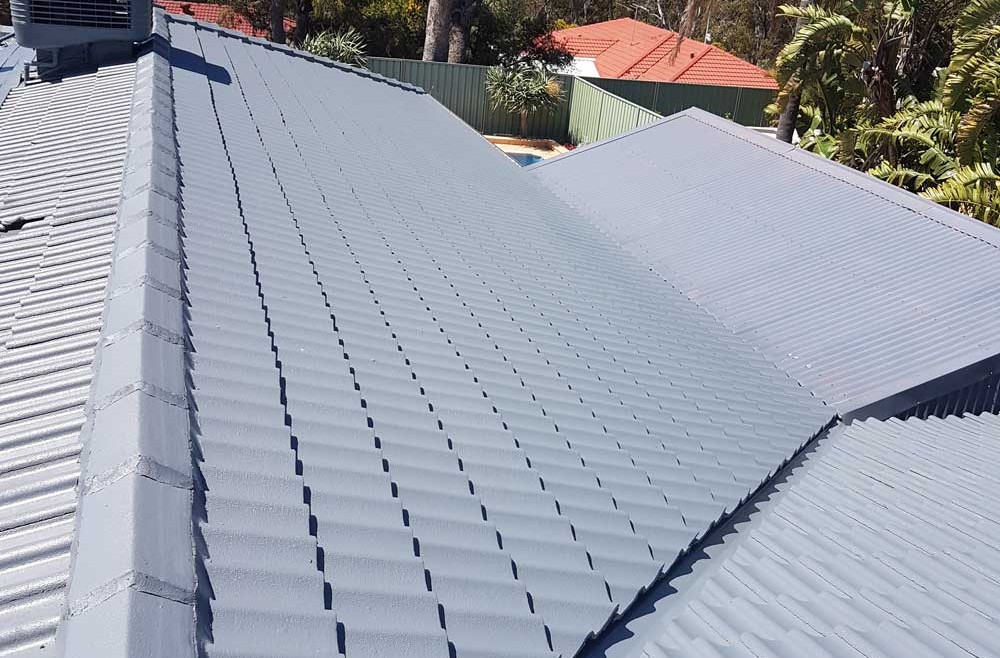
A proper restoration involves the same care as terracotta but with different products suited to the tile’s makeup — cleaning, repairs to bedding and pointing, a primer coat to lock in colour and seal porosity, then a high-build membrane coat that’s been engineered to flex with the tile rather than crack off in the sun. A well-executed cement tile roof restoration doesn’t just look sharp — it genuinely waterproofs your home again, which matters a lot more than the Instagram-worthy colour choice (though that’s a nice bonus).
Exterior Roof Painting: The Transformation Everyone Notices First
Here’s a fun fact most homeowners don’t clock until they’ve done it: a roof repaint is one of the few home improvements where the “before and after” photo genuinely stops the neighbours mid-walk. Beyond kerb appeal, though, exterior roof painting does real structural work. Quality roofing paint reflects UV, reduces heat transfer into the roof cavity (your air-con will thank you in January), and forms a protective membrane against the salt and moisture that cause premature ageing.
The trick is using paint systems actually formulated for Australian coastal conditions — not the cheap stuff that looks great for eighteen months then starts peeling like a bad sunburn. Colour choice matters too. Central Coast homes lean toward classic charcoals, basalts, and traditional terracotta tones that suit the coastal-bushland aesthetic without looking like they belong on a display home in Western Sydney.
Roof Cleaning and Treatment: The Unsung Hero
Everyone gets excited about a fresh coat of paint. Nobody gets excited about cleaning. And yet, roof cleaning and treatment is arguably the single most important — and most neglected — part of roof maintenance on the Coast.
Soft-wash, low-pressure cleaning removes moss, lichen, and organic buildup without cracking or dislodging tiles (a genuine risk with the old-school “blast it with a gurney” method some backyard operators still use). Follow it up with an anti-fungal treatment and you’ve bought yourself years before moss makes a comeback. Think of it as the roofing equivalent of a dental clean — not glamorous, but it stops much bigger, more expensive problems down the track.
When It’s Repair, Not Restoration
Not every roof needs the full treatment. Sometimes it’s a handful of cracked tiles after a storm, a leak around a skylight flashing, or a valley iron that’s started rusting through. That’s where targeted work from genuine roof repair specialists makes more sense than a full restoration — fix the actual problem, save the budget for when a full job is genuinely warranted. A decent local operator will tell you honestly which category your roof falls into, rather than upselling a restoration you don’t need yet.
Metal Roofs: When It’s Time to Let Go and Go Colorbond
Older tin and iron roofs eventually reach a point where painting over rust is just delaying the inevitable — like putting a plaster on a broken arm. Once corrosion has properly set into the sheeting, especially around fixing points and laps, a full Colorbond metal roof replacement becomes the smarter long-term investment. Modern Colorbond steel is purpose-built for Australian coastal conditions, with corrosion-resistant coatings that genuinely stand up to salt air rather than just surviving it for a decade.
Gutters and Fascias: The Bit Everyone Forgets Until Water’s Pouring Into the Ceiling
You can have the best roof on the street, but if your gutters and fascias are shot, water’s still finding its way where it shouldn’t. Sagging, rusted, or cracked guttering overflows during heavy rain, sends water back up under roof sheeting, and rots timber fascia boards over time. A gutter and fascia replacement is often the missing piece that finishes off a restoration properly — new guttering not only stops water damage but tidies up the whole roofline for a genuinely finished look.
Restore or Replace? The Honest Answer
Full roof replacement is expensive, disruptive, and — in most cases — completely unnecessary. Restoration typically costs a fraction of replacement while delivering a result that looks, and performs, close to brand new. It’s faster too; most restoration jobs wrap up in a matter of days rather than weeks. And unlike replacement, restoration keeps existing materials out of landfill, which is a small but genuine win if you care about that sort of thing (and increasingly, buyers do — a freshly restored roof is a real selling point if you’re thinking of listing).
Why Local Actually Matters Here
There’s a reason “local roofers Central Coast” gets searched so often, and it’s not just SEO habit — it’s that homeowners have been burned before by fly-in operators from Sydney who quote cheap, disappear halfway through the job, or use products never designed for coastal exposure. A proper local team understands microclimates suburb by suburb, holds current licensing and insurance, and — crucially — is still around in five years if a warranty claim ever comes up.
Two decades of restoring roofs from The Entrance to Terrigal, Gosford to Tuggerah teaches you things you simply can’t fake: which ridge lines cop the worst wind-driven rain, which streets are shaded enough to grow moss twice as fast, and which product actually holds its colour under Central Coast sun rather than chalking out in three summers.
What the Process Actually Looks Like
A properly run job follows a clear sequence: thorough roof inspection and honest assessment, tile or sheet repairs where needed, high-pressure or soft-wash cleaning, re-bedding and re-pointing of ridge capping, primer and sealant application, and a final quality check before the site’s left spotless. No surprise costs, no vague promises — just a roof that’s genuinely sorted for the next fifteen-plus years. If you want to see what that looks like in practice rather than just take our word for it, the completed projects gallery is worth a scroll — real Central Coast homes, real transformations.
The Bottom Line
Your roof is quietly having a rough time up there — copping sun, salt, and storms while you get on with life underneath it. Left unchecked, small issues become expensive ones fast. Caught early, though, most Central Coast roofs can be brought back to genuinely great condition without the cost or hassle of a full rebuild.
Whether it’s a terracotta roof that’s lost its glow, cement tiles looking tired and patchy, a metal roof past its prime, or gutters that can’t keep up with a decent downpour, sorting it now beats dealing with a ceiling stain later. Have a squiz at more practical roofing advice over on the blog, or if you’d rather just get an honest opinion on your own roof, reach out for a free, no-pressure quote — because a roof that’s earning its keep is worth a lot more than one that’s just quietly deteriorating overhead.